One Governance Architecture for Many Frameworks
Many frameworks. One enterprise. One way to govern it coherently.
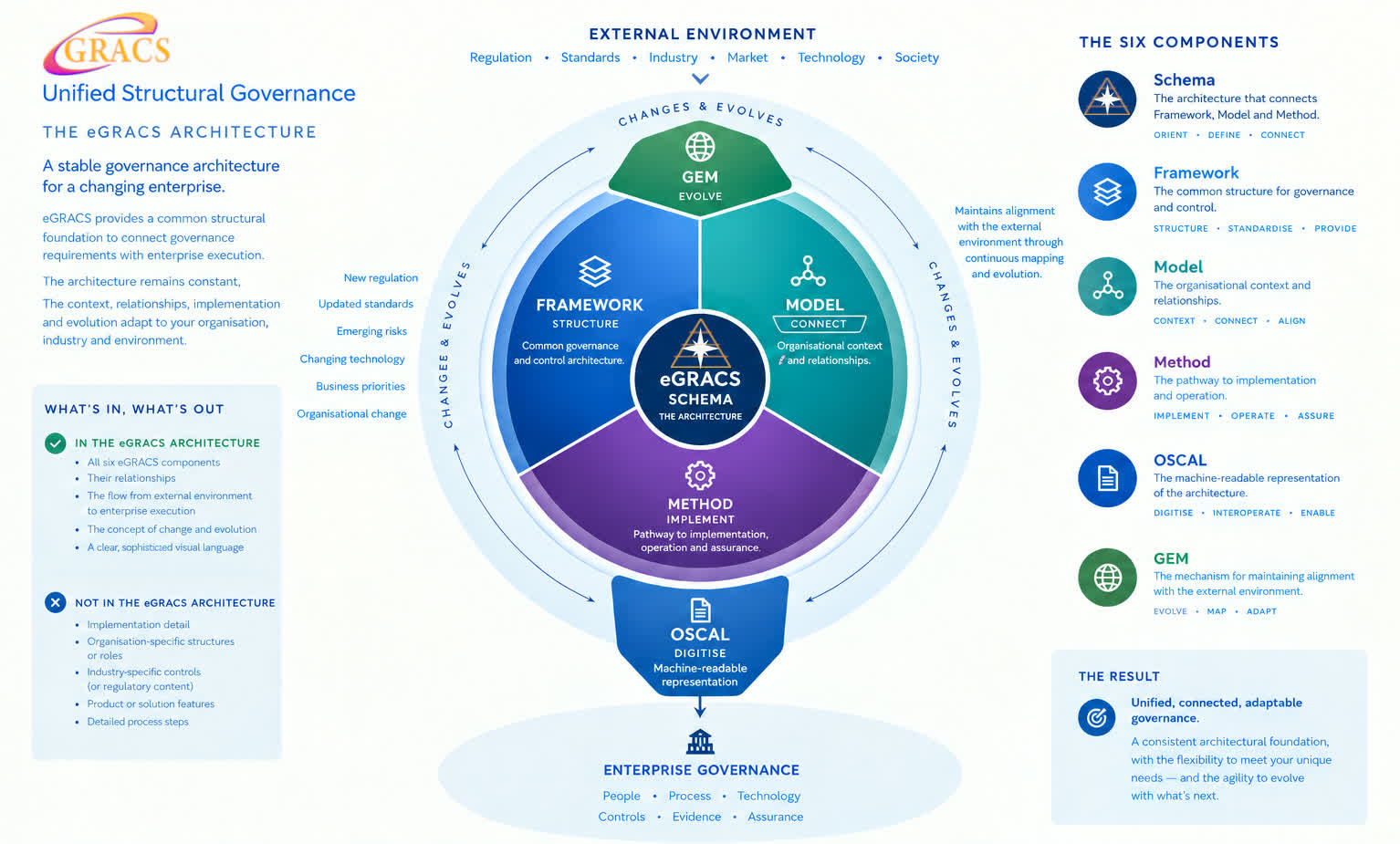
eGRACS™ is a unified structural governance architecture: stable at its core, adaptable at its edges.
The problem: governance is getting harder to hold together
Every new regulation tends to arrive as a project of its own, with its own controls, owners, evidence and audit cycle. Over time, frameworks accumulate faster than anyone can integrate them.
The result isn't necessarily poor governance. It's governance nobody can see as a whole: duplicated controls, the same evidence re-proved for each auditor, and no quick answer to "who owns this risk, and what shows it's managed?"
The answer: one architecture, not another rulebook
eGRACS is the connected governance architecture that sits underneath the standards, regulations and platforms you already use. It doesn't replace them, and external requirements stay authoritative. eGRACS gives them one structure to be related to.
Six components, six questions
| Orient | Component | The question it answers |
|---|---|---|
| Structure | Framework | Why does every new rule feel like a new rulebook? |
| Connect | Model | How do requirements become how we actually run? |
| Implement | Method | Does this mean starting over? |
| Digitise | eGRACS OSCAL Catalog | Why does our governance live in documents only people can read? |
| Evolve | GEM | What happens when the rules change again? |
The Schema orients the whole set: where do I start, and how do the pieces relate?
How the six fit together
Three components answer three different questions: the Framework defines the common architecture (what), the Model adapts it to one organisation (for whom), and the Method puts it into practice (how). The Schema shows how they relate. The eGRACS OSCAL Catalog puts the architecture into machine-readable form, and GEM keeps it aligned as standards, regulation, industry conditions and feedback change.
What this looks like in practice
Illustrative scenarios. They show what the architecture is designed to enable and are not customer case studies.
- Two organisations, one Framework. A 50-person startup and a 50,000-person bank can share one Framework. They end up with very different Models and Methods.
- A new privacy law arrives. Rather than launching a fresh compliance project from scratch, the organisation relates the law to its existing architecture. Parts of it may already be addressed, and the rest is scoped as a bounded piece of work.
- One evidence base. A board risk report and a regulatory audit can draw on the same underlying evidence, rather than each being assembled separately.
Where to start
- Executives, risk and audit leads: start with the Framework, then GEM.
- Implementation leads, programme managers, consultants: start with the Model, then the Method.
- Platform, automation and DevSecOps teams: start with the OSCAL Catalog.
- New to eGRACS: start with the Schema.
What eGRACS is not
- Not another compliance framework to add to the pile, and not a replacement for your standards or GRC platform.
- Not a compliance verdict. Mapping a requirement to an eGRACS control is a relationship, not proof of compliance.
- Not a reorganisation. No new job titles or committees are required.
- Not a substitute for judgement. Governance decisions stay with people.
Common questions
Does eGRACS replace our existing frameworks or GRC platform?
Does mapping to eGRACS make us compliant?
Do we have to adopt everything at once?
Do we need new roles or a new structure?
No registration required. Instant download.