Machine-Readable Governance Controls
Your governance lives in documents only people can read. Within eGRACS, OSCAL provides a mechanism through which governance structures and control information can be represented in machine-readable form.
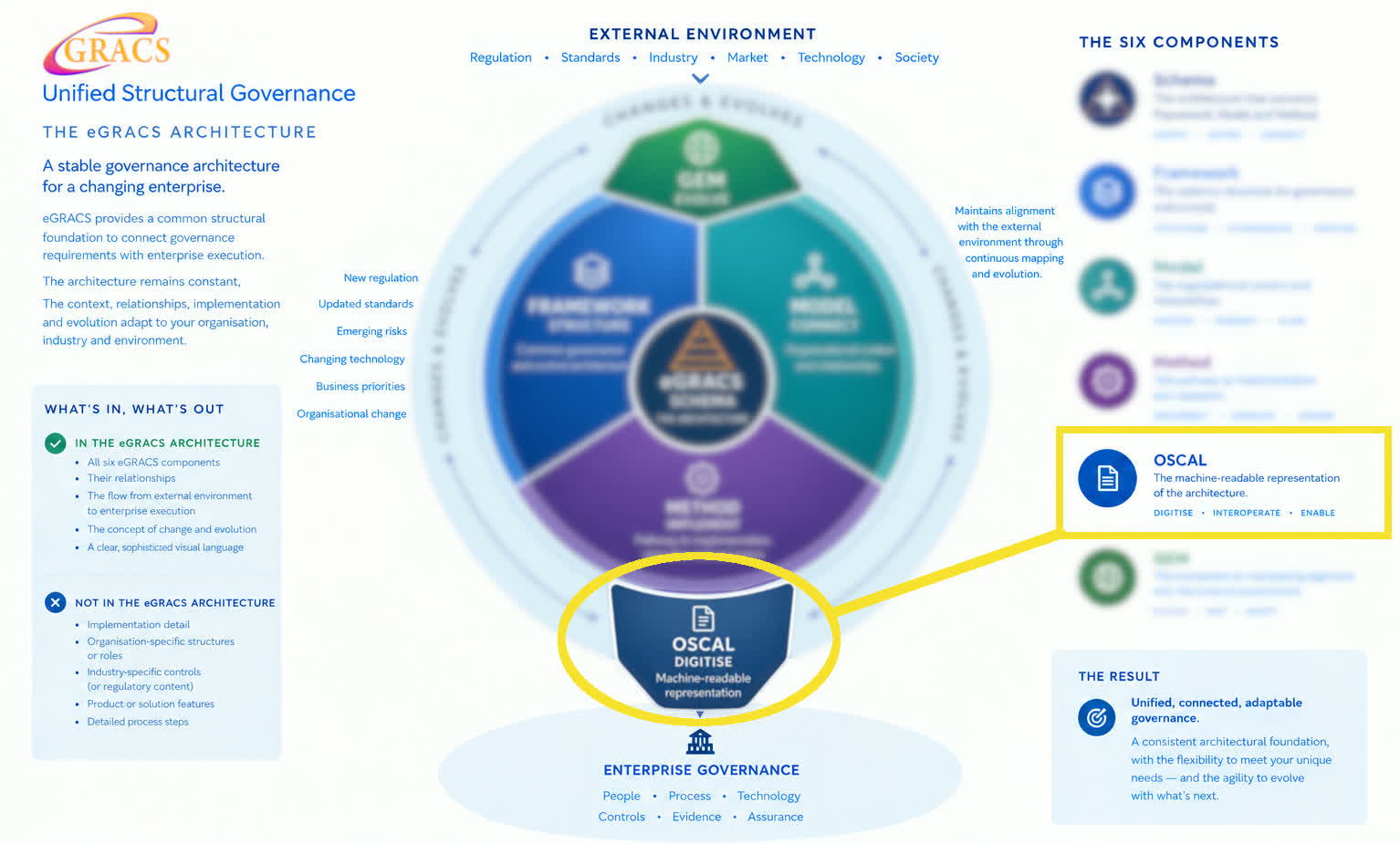
The eGRACS OSCAL Catalog (Digitise) is one of the six components of the eGRACS Unified Structural Governance Architecture. It represents the unified control architecture in machine-readable form, enabling governance information to be structured, mapped, contextualised, implemented, assessed and connected to technology-enabled governance..
The problem
Governance information mostly sits in documents and spreadsheets that one person at a time can interpret. That makes it slow to update, hard to monitor between audits and difficult to connect to the systems that run the business.
How it works
- The Catalog. The eGRACS controls, expressed in OSCAL, the NIST Open Security Controls Assessment Language: a structured, machine-readable format.
- Profiles. A completed Model becomes an OSCAL Profile: a selection and tailoring of controls for one context, in a form tools can consume.
- Connection. The same structured information can feed GRC platforms, continuous monitoring, evidence pipelines, and CI/CD and DevSecOps workflows, where your tooling supports it.
What it looks like in practice
Illustrative, not a case study.
Instead of manually cross-checking a spreadsheet against a platform each quarter, one structured source can feed the tools that need it, and updates flow from a single place.
Who it's for
Platform owners, automation engineers and DevSecOps teams building the technical plumbing beneath governance.
What it isn't
- Not a replacement for your GRC platform. It's the structure beneath it.
- Not a definition of governance. OSCAL represents governance intent once it's defined.
- Not automatic governance. Automation and AI can support collection, correlation and analysis, but accountability for decisions stays with people.
- Reference to NIST's OSCAL does not imply NIST endorsement of eGRACS.
No registration required. Instant download.