
 Series: Deep Dive
 📄 Transcript
Welcome to this explainer. Look, if you're a systems architect, an IT exec, or really anyone wrestling with enterprise governance right now, you know the pain. You are probably drowning in a sea of bloated compliance frameworks, endless mapping spreadsheets, and just a massive amount of duplicated effort.
Well, today we're gonna look at a real solution for that. We're diving into the eGRACS evolution and how architecting structural governance continuity is literally changing the game for IT compliance. Here's our blueprint for today.
We'll start with the fragmented compliance multiverse, move into unifying with structural governance, look at the golden triangle architecture, explore fractal tiers and safeguards, then securing the capability domain and wrap up with continuous compliance and confidence. Let's get right to it. Section one, the fragmented compliance multiverse.
Okay, so the root of this whole headache really starts back in the 1990s with general IT controls like COVID. Then, you know, the 2000s roll around and bring global security standards like ISO 27001 into the mix. After that, laws like Sarbanes-Oxley made certain controls mandatory.
And today, today we've got expansive risk-based frameworks like NIST CSF 2.0. But here's the catch. Historically, these frameworks didn't replace one another. We didn't swap them out, we just stacked them on top of each other.
The older ones asked, hey, do we have controls? Well, the newer ones ask, can we actually prove they work continuously? And this constant stacking, it just creates incredible operational bloat and a massive headache for governance professionals. And that stacking results in what I call a crisis of fragmentation. When enterprises have overlapping standards, think ISO, NIST, GDPR, HIPAA, SOC 2, they're forced into these exhausting mapping and interpretation exercises just to make those totally disparate control sets play nice together.
You're basically spending your time building complex translation engines instead of actually improving your security posture. It's just duplicated effort on a massive scale. Moving to section two, unifying with structural governance.
So how do we fix it? We need a fundamental paradigm shift. We need structural governance. Now, what exactly is that? Basically, it's an architectural approach that establishes a crystal clear separation of duties across three specific layers.
First, governance, which defines your strategic intent. Second, management, which handles all the operational coordination. And third, administration, which is your day-to-day technical execution.
High-performing enterprises leverage this exact structural separation to avoid common traps, like governance suddenly becoming way too operationally bloated or operational teams accidentally taking on governance duties they just aren't equipped for. The big takeaway here is moving away from the old premise. We absolutely have to stop focusing on the friction of cross-framework mapping and evolve toward the eGRACS premise, creating a continuous unified structural system that natively maps to those major standards for us.
It's all about seamless continuity instead of forced duct taped integration. Section three, the golden triangle architecture. Let's look at how this actually works.
Now, this is where it gets really interesting. Think of the eGRACS structural governance model as this overarching architectural umbrella. It essentially hovers above your existing domain-based models like COBIT, lifecycle-based ones like ITIL, and control-based models like ISO 27001.
It takes all those fragmented rules and consolidates them into one unified superset of controls. Basically, it acts as your universal translation layer so you don't have to manually juggle them all separately. Inno organizes this superset into three foundational domains.
You've got managed demand, which focuses on strategy and alignment, deliver solutions, dealing with design and implementation, and managed capability, handling lifecycle and support. This right here is the golden triangle architecture. It fosters balance, clarity, and this interconnected cybernetic symmetry that keeps your entire IT organization perfectly aligned.
All right, section four, fractal tiers and safeguards. For the systems architects tuning in, you're gonna love this part. Because organizations aren't simple, these golden triangles aren't just static shapes.
They actually use a tightly coupled fractal design that naturally expands outward and cascades downward. As your organization grows or gets more complex, the triangle replicates its structure, getting more specific at every single level, but never losing that foundational shape. This fractal cascade spreads across four functional tiers.
Up at the top, you have the core tier, dealing with high-level governance topics. Stepping down, it flows into the strategic tier, targeting specific governance areas. Then down into the operational tier where management actually implements the strategy.
And finally, hitting the tactical tier, which is all about daily administration. This is brilliant because it creates consistent structural symmetry with built-in scalability, meaning you never have to rip apart and redesign your organizational structure just to accommodate a newly updated compliance framework. And this tiered approach builds in total natural traceability.
These four tiers map perfectly to those core enterprise practices we mentioned, governance, management, and administration. This enables true top-down direction, taking board-level intent and pushing it seamlessly down to the front lines. But just as importantly, it enables bottom-up transformation, feeding day-to-day administrative safeguards right back up the chain to inform the board strategy.
Section five, securing the capability domain. Let's zoom into that managed capability domain for a second to show you exactly how security controls and infrastructure life cycles natively integrate within the structure. This domain is all about ensuring the ongoing performance and security of your IT backbone.
It manages the whole lifecycle of your applications, your infrastructure, and your services in a totally aligned way. Whether you're planning software interfaces, scaling up hardware capacity, or handling a disaster recovery incident, this domain is what guarantees your operations stay resilient. Look at the infrastructure lifecycle alone.
Technical safeguards are baked into absolutely every single step, from sourcing and acquisition, through deployment, into rigorous testing and validation, then proactive maintenance all the way to secure decommissioning at the end. By nesting these within the eGRACS framework, your security and capacity management seamlessly adapt to business demands. No more bolt-on siloed security workflows that slow everybody down.
And finally, section six, continuous compliance and confidence. Take a look at this quote with me. Enterprises do not lack governance frameworks.
They lack a structural system that keeps governance continuous. I mean, that absolutely hits the head, right? That is the core realization of the eGRACS evolution. Your issue isn't a lack of technical capability within your IT teams.
The issue is the lack of a unified translation layer connecting all those rules together functionally. And when you solve that, you get real-world outcomes. By focusing on cohesive structural governance rather than just siloed compliance rules, eGRACs drastically reduces your operational costs.
You get to completely ditch those bloated wrapping spreadsheets. You get guaranteed traceability from high-level board rescues down to individual technical safeguards. And it creates these incredible dashboards for top-down and bottom-up tracing.
Ultimately, it delivers the real executive prize, continuous compliance backed by absolute confidence. So I wanna leave you with this provocative question regarding your own enterprise architecture. As the regulatory landscape just continues to accelerate, is your enterprise still exhausted by mapping fragmented frameworks? Or are you finally ready to architect continuous compliance? Thank you so much for joining me on this explainer to explore the eGRACS evolution.
It is definitely time to stop stacking frameworks and start actually structuring for continuity.
 Series: Deep Dive
 📄 Transcript
Let's jump right into this explainer. If you work in IT, you know the headache, and honestly, the massive budget drain of trying to keep up with endless, conflicting standards. It's a nightmare, right? Well, today, we're going to look at a completely different, almost futuristic way to organize all this complexity using a structural approach called eGRACS.
So, let's start with a crucial question. How does your organization actually handle the chaos of overlapping compliance and security requirements? Think about it. You probably have one team looking at risk, another staring at security, and yet a third literally pulling their hair out over audits.
When these frameworks aren't speaking the exact same language, it creates massive inefficiencies, huge blind spots, and just unnecessary costs. If we look back from the 1980s up to the 2020s, you can see how our industry has basically just kept piling on layer after layer. I mean, we started with basic service management back in the 80s, added privacy and early security standards in the 90s, and then? Well, then it exploded into this crazy web of mature frameworks by the 2010s.
It's really no wonder organizations are struggling to keep it all straight. To untangle this, here's our agenda for today. One, the IT governance problem.
Two, the Golden Triangle solution. Three, fractal expansion of tiers. Four, governance, management, and administration.
Five, delivering secure IT solutions. And finally, six, unified structural governance. Starting right off with section one, the IT governance problem.
Okay, so to solve this massive fragmentation, eGRACS introduces this really cool concept, the golden triangle. Think of it as a perfectly balanced foundation for composing an elegant, unified governance structure. You know how a photographer or an artist uses the golden triangle to create a compelling, perfectly balanced composition? Well, eGRACS uses that exact same concept to organize three core control domains, manage demand, deliver solutions, and manage capability.
It literally forces clarity and proportion onto functions that are usually chaotic. Moving on to section two, the golden triangle solution. Now, what's great here is that the golden triangle doesn't just throw away your older models.
It actually harmonizes them. So domain-based frameworks like Cobit, they sit perfectly alongside lifecycle models like ITIL4 and control-based models like ISO 27001. This overarching triangle structure unifies the whole shebang.
Demand is met with effective solutions, and your operational capabilities are continuously managed. Simple, right? Let's check out section three, fractal expansion of tiers. This is where it gets really fascinating.
We see this single core golden triangle fractally expanding down through strategic, operational, and tactical tiers. Now, the absolute secret sauce to keeping this cascade perfectly aligned? Dashboards. Dashboards create seamless visibility between every single level.
So at the top, you have the core tier representing high-level governance topics. As we move down, that single triangle multiplies into the strategic tier, expands even further into the operational tier, and cascades right down into the highly detailed tactical tier. So the crucial takeaway here is how this cascade ensures that high-level enterprise intent naturally flows down into day-to-day administrative execution.
Nothing gets lost in translation. Why? Because the structure at the top is mathematically and logically identical to the structure at the bottom. This allows data to flow seamlessly back up through those interactive dashboards we just talked about.
All right, section four, governance, management, and administration. Notice how perfectly these line up. The core and strategic tiers strictly map to governance.
The operational tier maps directly to management. And the tactical tier? That maps to administration. So governance is setting the enterprise direction and oversight.
Management handles the execution oversight and coordination. And administration is doing the day-to-day execution. And remember, they aren't siloed.
They interact seamlessly using shared dashboards that are specifically tailored to their unique practice. Let's make this really concrete with a simple analogy. Think of it like a giant construction site.
Governance acts as the city planner. They're mapping out the zoning, the intent, and the big long-term vision. Management is the site foreman on the ground, coordinating the materials and overseeing the operational flow.
And Administration? Well, they're the builders, right? They're executing the day-to-day technical tasks, turning the blueprint into a reality. They all rely on the exact same master plan, just at completely different levels of detail. Next up, section five, delivering secure IT solutions.
Okay, let's track a real-world security requirement down this cascade within the deliver solutions domain. Up at the strategic tier, governance mandates managed solution implementation. Management then takes that down to the operational tier as managed solution testing, using their dashboards to ensure the enterprise architecture is being validated.
This guarantees that resources are perfectly balanced to meet those big strategic objectives across the design, build, and implementation phases. And finally, down at the tactical tier, our builders? Remember the administration practice? They execute specific cybersecurity testing protocols. The results of these tactical security tests, alongside unit and integration tests, populate those administrative dashboards.
And the best part? That data flows seamlessly right back up to management and governance. It mathematically proves that a high-level cybersecurity mandate is tactically verified before anything goes live. That is what true security by design looks like in action.
And our final part, section six, unified structural governance. When you step back and look at the whole picture, you realize that no matter what regulations you face, whether it's GDPR, HIPAA, NIST, or SOC2, the central eGRACS schema harmonizes them all under one single roof. By organizing your controls fractally into balanced domains, you don't need to invent a totally separate strategy for every single framework anymore.
This centralized schema sits beautifully at the intersection, satisfying the controls, the guidelines, and the reporting requirements of all of them, all at the exact same time. It's a real game changer. So I'll leave you with this final thought.
Are you going to continue juggling fractured IT controls, constantly reinventing the wheel for every new regulation? Or are you ready to embrace a unified structural future? The blueprint is right here. It's balanced, it's scalable, and it actually brings harmony back to IT. Thanks so much for joining me on this explainer, and I really hope this changes how you look at the architecture of your own IT governance.
 Series: Deep Dive
 📄 Transcript
Welcome to the Explainer. Today, we're embarking on a real tech futurist journey straight into the heart of enterprise architecture and governance.
Look, if you're a senior leader or an assurance practitioner, you already know that managing risk, security, and compliance in today's digital ecosystem is, well, it's incredibly complex. So we're going to explore a total paradigm shift today, the eGRACS framework, and look at how it literally transforms our foundational view of enterprise control. Now, I want you to really think about this question for a second.
Is a firewall configuration still a control at 3 a.m. when absolutely nobody is touching it? If you look at traditional audit-centric frameworks, the answer is usually, yes, of course. But we're actually going to challenge that traditional thinking today. We want to disrupt the assumption that controls are just static documents or set-and-forget technical configurations.
Okay, let's dive into this architectural blueprint for today. We'll trace the evolution of IT governance, redefine what an enterprise control actually is, explore the core triangle architecture, unpack the continuous learning loop, and finally bring it all together by unifying structural governance.
Part 1. The Evolution of IT Governance. You know, modern IT governance didn't just appear overnight. It evolved. Back in the 1930s, after the market crashes, we saw general corporate audit rules mature, which eventually gave us COSO.
By the 90s, with tech booming, IT-specific governance like COBIT emerged. Then, hitting the 2000s, international standards like ISO 2700 formalized, and suddenly security was a repeatable management system. And right after that, laws like Sarbanes-Oxley made all of this mandatory.
Fast forward to the 2020s, and we've got these massive cybersecurity frameworks like NIST CSF 2.0. But here's the catch. These frameworks never actually replaced each other. They just stacked up, decade after decade, like rigid blocks, leaving us with this really heavy fragmented tower of defensive mechanisms.
And this brilliantly illustrates what happens when you just keep stacking. We're left with this linear timeline of isolated frameworks. That's exactly why we need to leap away from piecemeal compliance towards the interconnected, unified structural governance of eGRACS, which we represent with a unified golden triangle.
The problem isn't that we don't have enough frameworks. It's that they were never ever designed to operate together as one continuous system. Which brings us to the harsh reality of the modern enterprise.
When your governance lacks a single continuous structure, you get an unbelievable amount of overlapping friction. I mean, compliance fatigue is real. Managing ISO 27001, NIST, GDPR, SOC2, and HIPAA all at once, that requires massive duplicated effort and complex mapping.
Teams end up spending way more time trying to translate controls across these silos than they actually do governing their digital ecosystems. Moving on to Part 2. Redefining Enterprise Controls I want to anchor our entire narrative right here with this powerful concept from the source material. An organization does not exist to implement controls.
An organization exists to achieve objectives. Period. Risk and opportunity only actually matter in relation to what your organization is trying to achieve.
Controls? They're just the vehicles helping you get there safely and successfully. Let's look at this sharp contrast. Traditionally, we've defined controls as static, defensive artifacts.
You know the ones. Dusty policies, standard operating procedures, set configurations that just try to modify uncertainty. But eGRACS flips the script.
In this view, controls are dynamic capabilities. They aren't just there to stop bad things. They are glowing, active nodes inside your enterprise that influence human, system, and AI behavior to actively hit your business targets.
A policy that nobody reads isn't a control. It's just a piece of paper. So the crucial point is right here in the eGRACS definition.
A control is a capability that influences both actions and emissions. Think about that for a second. Intentional inaction, like putting a freeze on system changes, is officially a governed behavior.
And what's really fascinating? This explicitly loops in AI. In a modern enterprise, AI decision-making is recognized as a behavior that absolutely must be guided by active controls. Alright, part three.
The COR triangle architecture. Meet the COR triangle. Control, opportunity, and risk.
Think of this like a structural truss you'd see in bridge design. The strength of that entire bridge relies on the perfect tension and balance between all three points. If you pull hard on one vertex, it immediately shifts the others.
So controls aren't just defensive shields meant to block risk. They are perfectly symmetrical peers to opportunity. Take an automated deployment pipeline, for example.
Yes, it's a control that reduces the risk of human error, but it simultaneously enables the opportunity to innovate way faster. And this fundamentally changes how we view risk and opportunity all together. Under older models, like ISO 31000, risk was just the effect of uncertainty, like it just exists out there in the ether.
But eGRACS traces both risk and opportunity directly back to organizational actions or intentional inactions. If a risk pops up, it's because a human, a system, or an AI did something or failed to do something that exposed the business to that uncertainty. Which leads us to part four.
The continuous learning loop. Let's move to this maturity journey and see how this interconnectedness actually plays out. At step one, low maturity, it's basically organized chaos, reactive silos where actions lead to total surprise consequences.
By step two, medium maturity, controls do start shaping outcomes, but the learning is super inconsistent. But step three, high maturity? That's where the COR triangle acts as a true cybernetic feedback loop. Mature organizations take realized risks, say a phishing breach, and realized opportunities, like a wildly successful AI pilot, and use them as vital intel.
They continuously learn from both unexpected wins and failures to dynamically optimize their controls. Finally, part five. Unifying structural governance.
What's really cool is how eGRACS positions itself. It doesn't just toss yet another framework onto your already overflowing plate. Instead, it operates as a structural superset that hovers above your domain models like COBIT, lifecycle models like ITIL, and control models like ISO 27001.
It uses this brilliant fractal design, cascading naturally through governance, management, and administration tiers. This guarantees seamless traceability, meaning you can trace a high-level board risk theme straight down to a granular technical safeguard without having to constantly redesign your structure. At the very top of this architecture, we have the golden triangle, which cleanly organizes all these controls into three tightly coupled domains.
First, manage demand, which is all about aligning your strategic initiatives and assurance with actual resources. Second, deliver solutions, focusing on securely building and implementing those systems. And third, manage capability, making sure you have ongoing lifecycle management of your tech infrastructure.
Think of these three domains sort of like composition and cinematography. They perfectly balance the frame, ensuring total harmony between what the business demands, what IT actually delivers, and how systems are actively managed. So we've walked through the evolution of all those old frameworks, uncovered the active, dynamic nature of modern controls, and explored the beautifully balanced architecture of eGRACS.
But I want to leave you with one final, provocative question to take back to your teams today. Are your enterprise controls merely static compliance documents sitting forgotten in some shared folder, or are they the active, cybernetic nervous system dynamically driving your organization's future? The choice of structure is entirely up to you. Thanks so much for joining this explainer, and keep learning!
 Series: Deep Dive
 📄 Transcript
All right, let's jump right into this eGRACS OSCAL explainer.
Today, we're unpacking a pretty major executive briefing, and we are going to look at how we can fundamentally transform enterprise governance. We're talking about shifting from static, frustrating text into dynamic, executable code.
Look, if you've been managing enterprise risk and compliance for any amount of time, you absolutely know the struggle of overlapping standards and those never ending audit cycles. So today we're going to break down the eGRACS OSCAL integration to show you exactly how to turn all that complexity into a serious, undeniable strategic advantage. Now I love this because it completely redefines governance.
We're so used to thinking of compliance as this massive roadblock, right? Like a cage of rigid rules that just bogs down innovation. But this quote from the eGRACS framework completely shifts that paradigm. Control, when you architect it correctly, isn't a cage at all.
It's actually the very foundation of operational resilience. It is the exact thing that allows your business to move fast and innovate safely, because you know for a fact that the guardrails are seamlessly built right into the process. So here is our quick roadmap for this explainer.
One, the illusion of control. Two, machine-readable governance. Three, continuous control monitoring. Four, automated regulatory intelligence. Five, cross-framework mapping. And finally, six, the strategic advantage.
Let's start with section one, the illusion of control moving past fragmented compliance. We really need to start with a hard truth here. The old way of doing things is basically an illusion of control.
It's governance held together by duct tape, siloed spreadsheets, and those reactive fire drills that only seem to happen when an audit report is about to drop. Well, the new way with eGRACS is a unified dynamic architecture. It's proactive by design.
It creates this interconnected system where your risk registers, security controls, and audit tasks all flow from the exact same core. Instead of living in completely separate universes, they're automatically informing each other. Moving right along to section two, machine-readable governance from static text to dynamic code.
Okay. So how do we actually make this huge leap? Well, the answer is OSCAL, which stands for the Open Security Controls Assessment Language from NIST. Honestly, this is the absolute game changer.
OSCAL basically transforms those thick, heavy binders of static governance frameworks into structured, machine-readable data pipelines. So instead of reading a control like a dusty paragraph in a PDF, OSCAL breaks it down into structured data components. It literally turns governance into something that your automation platforms, your CI/CD pipelines, and your AI tools can reliably and instantly consume.
Let's see how that actually builds out our core technology stack. The eGRACS OSCAL toolchain functions as this beautifully seamless pipeline. It starts right at the top with the catalog, which is your authoritative library of 120 unified ICT controls.
From there, you apply a profile. That's your tailored organizational baseline that selectively adjusts the controls you actually need. And finally, you have the system security plan or SSP, which serves as your operational implementation map.
This is what connects those high-level strategic controls directly to the actual technical components, teams, and servers running in your environment. Which brings us to section three, continuous control monitoring, the end of audit fire drills. This fundamentally changes how we track compliance, especially in the cloud.
Let's look at how this plays out in practice. First, you define your baseline via the profile. Second, you map out your system components via the SSP.
Now, because that SSP is machine-readable data, you can actually treat it as an engineering artifact right inside your CI/CD pipelines alongside your infrastructure as code. Step three is automating your evidence collection by licking those components straight to your telemetry tools. And step four, continuous assessment.
The status of your compliance remains continuously current with literally zero manual intervention. What you really need to take away from this is that the eGRACS OSCAL catalog provides the programmatic anchor required for true cloud native continuous monitoring. Your governance is now evolving precisely alongside your infrastructure.
What used to be a highly stressful, totally reactive yearly audit transforms into a silent automated feedback loop. The evidence collection is continuous and your board gets real-time visibility into your actual compliance posture. All right, section four, automated regulatory intelligence, proactive radar for shifting global laws.
If you want to future-proof your enterprise against a constantly volatile regulatory landscape, this is how you do it. Shifting global laws are automatically mapped directly into your existing control structure through a process eGRACS calls continuous normalization. So whether you're mapping privacy controls for GDPR or integrating algorithmic risk for the brand new EU AI act, or just syncing security baselines for ISO 27,001, the eGRACS schema simply adapts.
It acts as a proactive radar. You are never scrambling to invent brand new controls from scratch. Every single time a new law is passed.
And here is where it becomes a massive operational advantage for your tech stack. eGRACS OSCAL transforms these incredibly complex regulations into structured machine readable data. Basically, by converting dense regulatory text into a consumable JSON format, we are handing your automation tools and large language models, the ultimate actionable intelligence, your AI platforms can now reliably consume and analyze this data to automatically flag any gaps in your compliance posture.
It's pretty amazing. Let's dive into section five, cross-framework mapping, the ultimate efficiency engine. We have to talk about tackling the immense bloat and cost of overlapping compliance requirements.
Look, instead of trying to manage thousands of redundant, frankly confusing check boxes spread across dozens of different spreadsheets, the eGRACS framework consolidates the whole thing. It takes the absolute best elements of global standards and fuses them into exactly 120 unified right-sized ICT controls. And using the eGRACS control mapping model, which is brilliantly implemented through OSCAL, mappings to all these global frameworks become perfectly structured, repeatable, and automatically maintainable.
Think about what that means. When you satisfy just one of those 120 core controls, you are automatically satisfying the corresponding requirements in ISO 27001, PCI DSS, HIPAA, and a ton of others. It completely eradicates the redundant effort of trying to bolt on multiple rigid frameworks one by one.
But here's the really clever part. It's not just a flat list of 120 items. Those controls are organized into 40 golden triangles.
These are highly interdependent triads that form self-balancing micro-ecosystems. Because these controls are linked together this way, when you update just one tactical control, the mapping context automatically adapts across the rest of the triangle. It's a living, dynamic control architecture that creates incredible structural resilience for the entire enterprise.
Finally, section six, the strategic advantage, governance as a competitive edge. Let's tie all this tech futurism directly back to your bottom line and your operational ROI. By embracing this hybrid implementation, where high-level strategy effortlessly meets tactical automation, you secure a phenomenal executive ROI.
You establish a unified single source of truth that allows the board to maintain real strategic oversight. And because the framework is fractal, it scales seamlessly across four governance tiers, from the core all the way down to tactical day-to-day operations. You get direct integration into DevSecOps, and perhaps most importantly, you totally eradicate the costs associated with redundant manual compliance efforts.
So you really have to ask yourself, is your enterprise ready to stop just merely surviving audits? Are you ready to actually start using automated governance to drive secure, highly agile innovation? Because the tools to transform your organization's DNA are sitting right in front of you. Ultimately, the key takeaway from this explainer is that implementing the eGRACS OSCAL tool chain is so much more than just a standard IT upgrade. It is the operational structure that truly sets your enterprise free.
It takes governance, which has historically been a costly, slow-moving burden, and turns it into a massive competitive advantage. The only question left is, how much longer can your organization afford to be held back by the illusion of control?
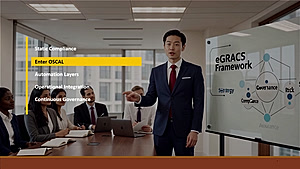 Series: Deep Dive
 📄 Transcript
Welcome to this eGRACS OSCAL Explainer.
We are jumping right in today because we're tackling a massive bottleneck that plagues almost every single large organization out there. Static compliance.
Look, if your enterprise is still managing governance through isolated PDFs, disconnected spreadsheets, and you know, those panicked audit fire drills, you're losing time, money, and most importantly, agility. Today, we're exploring a tech futurist concept that is actually already a reality. We're going to see exactly how the eGRACS framework uses OSCAL to transform totally static, bureaucratic governance into a sleek, automated, machine-readable pipeline.
Okay, let's dive into this system boot sequence. We'll hit 1. The static compliance trap. 2. Enter the OSCAL standard. 3. Three layers of automation. 4. Operational integration. And finally, 5. The continuous governance future.
Section one, the static compliance trap. Let's start with the root of the problem. The way we've traditionally handled compliance is just fundamentally broken for modern enterprise architectures.
Traditional compliance relies heavily on isolated PDFs and manual spreadsheets. But think about it, a periodic manual audit is literally obsolete the very second it gets printed, right? It's just a static snapshot of a highly dynamic environment. Whenever an auditor shows up or a regulator tweaks the rules, someone invariably yells, wait, do we have a control for this? And total chaos ensues.
OSCAL governance is a total game changer here. It relies on machine-readable JSON, continuous monitoring, and interconnected data to replace those awful fire drills with a continuous automated flow of truth. Section two, enter the OSCAL standard.
So what's the technological paradigm shift that rescues us from this spreadsheet trap? Well, OSCAL stands for the Open Security Controls Assessment Language, a standard originally created by NIST. At its core, it's a standardized machine-readable JSON format. And why does this matter so much for you? Because AI and compliance platforms really struggle to parse traditional PDF manuals.
Natural language is just too fragmented and ambiguous. OSCAL actually takes those natural language regulations and transforms them into structured data. It acts as this ultimate digital foundation, literally letting your governance framework speak the exact same language as your cloud-native infrastructure.
Now, what's really interesting about this slide is this exact quote from the eGRACS documentation. We believe enterprises do not lack governance frameworks. They lack a structural system that keeps governance continuous.
It hits the nail on the head. Your organization probably has plenty of rules, right? You don't need more controls. You need connected controls.
The issue has always been structural connectivity. Section three, three layers of automation. Let's move to and see how this builds into an actual architectural toolchain.
This automation pipeline is built on three distinct governance pillars, taking us straight from theory into operational reality. Step one, the eGRACS catalog. Step two, the profile. And step three, the system security plan or the SSP. You can think of this as a highly logical step-by-step progression where governance data just flows seamlessly down into your actual IT operations. Let's break each of these down.
First up, we've got the eGRACS catalog. This is essentially your master digital blueprint. Containing your complete control library.
But here is the absolute genius part of it. It separates organizational identities from the controls themselves using UUIDs. This means human actors like your CIO, the internal audit team, or your SOC are defined exactly once in the metadata.
When you import this catalog into a GRC platform, you just sync it up with your corporate identity provider. Ownership and responsibility are mapped entirely automatically. No more duplicate administrative headaches.
Next we apply the eGRACS profile. Obviously you don't need every single control from the master catalog for every system you run. So the profile selects and tailors the controls that form your organization's specific baseline.
And it does this using native HREF relationships to essentially point back to the master catalog. This is incredibly crucial because it lets you create a customized self-balancing baseline without ever altering or worse, breaking the master catalog itself. Okay.
So we have a master library and we have a beautifully tailored baseline, but a baseline is still at the end of the day, just a plan. How does this theoretical governance actually become operational down on the ground level? The answer to that is our third pillar, the system security plan or the SSP. This right here is where governance finally meets reality.
The SSP documents exactly how your selected controls are implemented across your real living systems. It models your environment as discrete components. We're talking virtual machines, Kubernetes clusters, enterprise firewalls, and even operational teams like your incident response crew.
You map your specific implementation statements directly to the specific components responsible for delivering them. It creates perfect unbroken traceability from a high level board requirement all the way down to a single SAS application. Section four, operational integration.
Let's talk about how this machine readable data physically plugs into your enterprise platforms. And this brilliantly illustrates how OSQL data maps directly into big GRC solutions like ServiceNow IRM or RegScale. The eGRACS framework actually extends OSQL with custom properties.
Look at how these JSON properties embedded in the code automatically populate native platform attributes the second they're imported. For instance, the confidentiality impact property automatically sets the confidentiality classification inside your platform. That means you are automating risk classification immediately out of the Assets with a high confidentiality impact can automatically trigger an inherent enhanced monitoring workflows.
It's incredibly slick. Plus, because we are strictly dealing with code here, we can start treating governance as infrastructure as code. You can integrate these OSQL baselines right into your existing CI/CD pipelines.
You just store your compliance artifacts and version control repositories like it. You can mandate peer reviews for policy changes before they go live. You can run automated scripts to validate the JSON schema before deployment.
And once a change is approved, APIs sync that update directly to your GRC platform. You are literally managing compliance with the exact same GitOps maturity, peer review and automation that your engineers use for software releases. 120.
That is the number of unified ICT controls sitting right at the center of the eGRACS framework. But here's where it gets crazy. Through the power of OSQL and this automated pipeline, those 120 base controls are continuously mapped across 22 different global regulations.
We're talking everything from GDPR and ISO 27,001 to HIPAA and the new EU AI Act. You only have to implement a control once in your SSP and the automation handles the entire cross-framework mapping. That's the immense scale that is only made possible by a machine readable pipeline.
Section five, the continuous governance future. So the crucial point is this, structured interconnected control data absolutely sets your organization free to innovate quickly and safely. With OSQL, you're unlocking automated regulatory intelligence simply because your data is finally AI ready.
You enable continuous control monitoring, meaning your cloud native systems can automatically collect evidence to prove a control is doing its job. You get that automated cross-framework mapping for things like COVID, NIST, and ISO 27,001, and most importantly of all, you achieve continuous normalization. As global laws and technologies inevitably evolve, your entire governance ecosystem is updated in unison, flowing completely automatically from your master catalog down to your ground level system components.
I really want to leave you with this final somewhat provocative thought to consider today. When you look closely at your enterprise's current governance architecture, what do you actually see? Is it just a collection of static, isolated documents that do nothing but paralyze your teams every time an audit rolls around, or is it a living continuous operating system built on structured data that actually evolves at the speed of your business? Look, if you want true agility, it might be time to start building your automation pipeline today. Thanks so much for joining me on this explainer, and keep learning.
Subscribe to Our Video Updates
Stay informed with the latest eGRACS tutorials, insights, and strategies by subscribing to our video updates.
Looking for more?
🔍Search🏆Accreditation
eGRACS Accrediation

🤝Calling Consultants
Independent Consultants

🤽Video Explainers
What is eGRACS
🎧Vodcasts
eGRACS Framework Intro