 Series: Deep Dive
 📄 Transcript
Welcome to this eGRACS OSCAL Explainer.
We are jumping right in today because we're tackling a massive bottleneck that plagues almost every single large organization out there. Static compliance.
Look, if your enterprise is still managing governance through isolated PDFs, disconnected spreadsheets, and you know, those panicked audit fire drills, you're losing time, money, and most importantly, agility. Today, we're exploring a tech futurist concept that is actually already a reality. We're going to see exactly how the eGRACS framework uses OSCAL to transform totally static, bureaucratic governance into a sleek, automated, machine-readable pipeline.
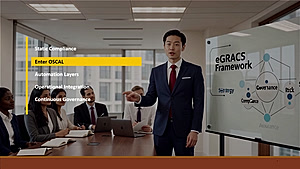
Okay, let's dive into this system boot sequence. We'll hit 1. The static compliance trap. 2. Enter the OSCAL standard. 3. Three layers of automation. 4. Operational integration. And finally, 5. The continuous governance future.
Section one, the static compliance trap. Let's start with the root of the problem. The way we've traditionally handled compliance is just fundamentally broken for modern enterprise architectures.
Traditional compliance relies heavily on isolated PDFs and manual spreadsheets. But think about it, a periodic manual audit is literally obsolete the very second it gets printed, right? It's just a static snapshot of a highly dynamic environment. Whenever an auditor shows up or a regulator tweaks the rules, someone invariably yells, wait, do we have a control for this? And total chaos ensues.
OSCAL governance is a total game changer here. It relies on machine-readable JSON, continuous monitoring, and interconnected data to replace those awful fire drills with a continuous automated flow of truth. Section two, enter the OSCAL standard.
So what's the technological paradigm shift that rescues us from this spreadsheet trap? Well, OSCAL stands for the Open Security Controls Assessment Language, a standard originally created by NIST. At its core, it's a standardized machine-readable JSON format. And why does this matter so much for you? Because AI and compliance platforms really struggle to parse traditional PDF manuals.
Natural language is just too fragmented and ambiguous. OSCAL actually takes those natural language regulations and transforms them into structured data. It acts as this ultimate digital foundation, literally letting your governance framework speak the exact same language as your cloud-native infrastructure.
Now, what's really interesting about this slide is this exact quote from the eGRACS documentation. We believe enterprises do not lack governance frameworks. They lack a structural system that keeps governance continuous.
It hits the nail on the head. Your organization probably has plenty of rules, right? You don't need more controls. You need connected controls.
The issue has always been structural connectivity. Section three, three layers of automation. Let's move to and see how this builds into an actual architectural toolchain.
This automation pipeline is built on three distinct governance pillars, taking us straight from theory into operational reality. Step one, the eGRACS catalog. Step two, the profile. And step three, the system security plan or the SSP. You can think of this as a highly logical step-by-step progression where governance data just flows seamlessly down into your actual IT operations. Let's break each of these down.
First up, we've got the eGRACS catalog. This is essentially your master digital blueprint. Containing your complete control library.
But here is the absolute genius part of it. It separates organizational identities from the controls themselves using UUIDs. This means human actors like your CIO, the internal audit team, or your SOC are defined exactly once in the metadata.
When you import this catalog into a GRC platform, you just sync it up with your corporate identity provider. Ownership and responsibility are mapped entirely automatically. No more duplicate administrative headaches.
Next we apply the eGRACS profile. Obviously you don't need every single control from the master catalog for every system you run. So the profile selects and tailors the controls that form your organization's specific baseline.
And it does this using native HREF relationships to essentially point back to the master catalog. This is incredibly crucial because it lets you create a customized self-balancing baseline without ever altering or worse, breaking the master catalog itself. Okay.
So we have a master library and we have a beautifully tailored baseline, but a baseline is still at the end of the day, just a plan. How does this theoretical governance actually become operational down on the ground level? The answer to that is our third pillar, the system security plan or the SSP. This right here is where governance finally meets reality.
The SSP documents exactly how your selected controls are implemented across your real living systems. It models your environment as discrete components. We're talking virtual machines, Kubernetes clusters, enterprise firewalls, and even operational teams like your incident response crew.
You map your specific implementation statements directly to the specific components responsible for delivering them. It creates perfect unbroken traceability from a high level board requirement all the way down to a single SAS application. Section four, operational integration.
Let's talk about how this machine readable data physically plugs into your enterprise platforms. And this brilliantly illustrates how OSQL data maps directly into big GRC solutions like ServiceNow IRM or RegScale. The eGRACS framework actually extends OSQL with custom properties.
Look at how these JSON properties embedded in the code automatically populate native platform attributes the second they're imported. For instance, the confidentiality impact property automatically sets the confidentiality classification inside your platform. That means you are automating risk classification immediately out of the Assets with a high confidentiality impact can automatically trigger an inherent enhanced monitoring workflows.
It's incredibly slick. Plus, because we are strictly dealing with code here, we can start treating governance as infrastructure as code. You can integrate these OSQL baselines right into your existing CI/CD pipelines.
You just store your compliance artifacts and version control repositories like it. You can mandate peer reviews for policy changes before they go live. You can run automated scripts to validate the JSON schema before deployment.
And once a change is approved, APIs sync that update directly to your GRC platform. You are literally managing compliance with the exact same GitOps maturity, peer review and automation that your engineers use for software releases. 120.
That is the number of unified ICT controls sitting right at the center of the eGRACS framework. But here's where it gets crazy. Through the power of OSQL and this automated pipeline, those 120 base controls are continuously mapped across 22 different global regulations.
We're talking everything from GDPR and ISO 27,001 to HIPAA and the new EU AI Act. You only have to implement a control once in your SSP and the automation handles the entire cross-framework mapping. That's the immense scale that is only made possible by a machine readable pipeline.
Section five, the continuous governance future. So the crucial point is this, structured interconnected control data absolutely sets your organization free to innovate quickly and safely. With OSQL, you're unlocking automated regulatory intelligence simply because your data is finally AI ready.
You enable continuous control monitoring, meaning your cloud native systems can automatically collect evidence to prove a control is doing its job. You get that automated cross-framework mapping for things like COVID, NIST, and ISO 27,001, and most importantly of all, you achieve continuous normalization. As global laws and technologies inevitably evolve, your entire governance ecosystem is updated in unison, flowing completely automatically from your master catalog down to your ground level system components.
I really want to leave you with this final somewhat provocative thought to consider today. When you look closely at your enterprise's current governance architecture, what do you actually see? Is it just a collection of static, isolated documents that do nothing but paralyze your teams every time an audit rolls around, or is it a living continuous operating system built on structured data that actually evolves at the speed of your business? Look, if you want true agility, it might be time to start building your automation pipeline today. Thanks so much for joining me on this explainer, and keep learning.
 Series: Deep Dive
 📄 Transcript
Welcome to the Explainer. Today, we're embarking on a real tech futurist journey straight into the heart of enterprise architecture and governance.
Look, if you're a senior leader or an assurance practitioner, you already know that managing risk, security, and compliance in today's digital ecosystem is, well, it's incredibly complex. So we're going to explore a total paradigm shift today, the eGRACS framework, and look at how it literally transforms our foundational view of enterprise control. Now, I want you to really think about this question for a second.
Is a firewall configuration still a control at 3 a.m. when absolutely nobody is touching it? If you look at traditional audit-centric frameworks, the answer is usually, yes, of course. But we're actually going to challenge that traditional thinking today. We want to disrupt the assumption that controls are just static documents or set-and-forget technical configurations.
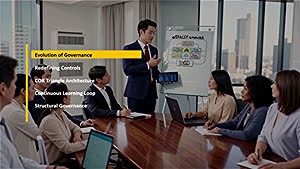
Okay, let's dive into this architectural blueprint for today. We'll trace the evolution of IT governance, redefine what an enterprise control actually is, explore the core triangle architecture, unpack the continuous learning loop, and finally bring it all together by unifying structural governance.
Part 1. The Evolution of IT Governance. You know, modern IT governance didn't just appear overnight. It evolved. Back in the 1930s, after the market crashes, we saw general corporate audit rules mature, which eventually gave us COSO.
By the 90s, with tech booming, IT-specific governance like COBIT emerged. Then, hitting the 2000s, international standards like ISO 2700 formalized, and suddenly security was a repeatable management system. And right after that, laws like Sarbanes-Oxley made all of this mandatory.
Fast forward to the 2020s, and we've got these massive cybersecurity frameworks like NIST CSF 2.0. But here's the catch. These frameworks never actually replaced each other. They just stacked up, decade after decade, like rigid blocks, leaving us with this really heavy fragmented tower of defensive mechanisms.
And this brilliantly illustrates what happens when you just keep stacking. We're left with this linear timeline of isolated frameworks. That's exactly why we need to leap away from piecemeal compliance towards the interconnected, unified structural governance of eGRACS, which we represent with a unified golden triangle.
The problem isn't that we don't have enough frameworks. It's that they were never ever designed to operate together as one continuous system. Which brings us to the harsh reality of the modern enterprise.
When your governance lacks a single continuous structure, you get an unbelievable amount of overlapping friction. I mean, compliance fatigue is real. Managing ISO 27001, NIST, GDPR, SOC2, and HIPAA all at once, that requires massive duplicated effort and complex mapping.
Teams end up spending way more time trying to translate controls across these silos than they actually do governing their digital ecosystems. Moving on to Part 2. Redefining Enterprise Controls I want to anchor our entire narrative right here with this powerful concept from the source material. An organization does not exist to implement controls.
An organization exists to achieve objectives. Period. Risk and opportunity only actually matter in relation to what your organization is trying to achieve.
Controls? They're just the vehicles helping you get there safely and successfully. Let's look at this sharp contrast. Traditionally, we've defined controls as static, defensive artifacts.
You know the ones. Dusty policies, standard operating procedures, set configurations that just try to modify uncertainty. But eGRACS flips the script.
In this view, controls are dynamic capabilities. They aren't just there to stop bad things. They are glowing, active nodes inside your enterprise that influence human, system, and AI behavior to actively hit your business targets.
A policy that nobody reads isn't a control. It's just a piece of paper. So the crucial point is right here in the eGRACS definition.
A control is a capability that influences both actions and emissions. Think about that for a second. Intentional inaction, like putting a freeze on system changes, is officially a governed behavior.
And what's really fascinating? This explicitly loops in AI. In a modern enterprise, AI decision-making is recognized as a behavior that absolutely must be guided by active controls. Alright, part three.
The COR triangle architecture. Meet the COR triangle. Control, opportunity, and risk.
Think of this like a structural truss you'd see in bridge design. The strength of that entire bridge relies on the perfect tension and balance between all three points. If you pull hard on one vertex, it immediately shifts the others.
So controls aren't just defensive shields meant to block risk. They are perfectly symmetrical peers to opportunity. Take an automated deployment pipeline, for example.
Yes, it's a control that reduces the risk of human error, but it simultaneously enables the opportunity to innovate way faster. And this fundamentally changes how we view risk and opportunity all together. Under older models, like ISO 31000, risk was just the effect of uncertainty, like it just exists out there in the ether.
But eGRACS traces both risk and opportunity directly back to organizational actions or intentional inactions. If a risk pops up, it's because a human, a system, or an AI did something or failed to do something that exposed the business to that uncertainty. Which leads us to part four.
The continuous learning loop. Let's move to this maturity journey and see how this interconnectedness actually plays out. At step one, low maturity, it's basically organized chaos, reactive silos where actions lead to total surprise consequences.
By step two, medium maturity, controls do start shaping outcomes, but the learning is super inconsistent. But step three, high maturity? That's where the COR triangle acts as a true cybernetic feedback loop. Mature organizations take realized risks, say a phishing breach, and realized opportunities, like a wildly successful AI pilot, and use them as vital intel.
They continuously learn from both unexpected wins and failures to dynamically optimize their controls. Finally, part five. Unifying structural governance.
What's really cool is how eGRACS positions itself. It doesn't just toss yet another framework onto your already overflowing plate. Instead, it operates as a structural superset that hovers above your domain models like COBIT, lifecycle models like ITIL, and control models like ISO 27001.
It uses this brilliant fractal design, cascading naturally through governance, management, and administration tiers. This guarantees seamless traceability, meaning you can trace a high-level board risk theme straight down to a granular technical safeguard without having to constantly redesign your structure. At the very top of this architecture, we have the golden triangle, which cleanly organizes all these controls into three tightly coupled domains.
First, manage demand, which is all about aligning your strategic initiatives and assurance with actual resources. Second, deliver solutions, focusing on securely building and implementing those systems. And third, manage capability, making sure you have ongoing lifecycle management of your tech infrastructure.
Think of these three domains sort of like composition and cinematography. They perfectly balance the frame, ensuring total harmony between what the business demands, what IT actually delivers, and how systems are actively managed. So we've walked through the evolution of all those old frameworks, uncovered the active, dynamic nature of modern controls, and explored the beautifully balanced architecture of eGRACS.
But I want to leave you with one final, provocative question to take back to your teams today. Are your enterprise controls merely static compliance documents sitting forgotten in some shared folder, or are they the active, cybernetic nervous system dynamically driving your organization's future? The choice of structure is entirely up to you. Thanks so much for joining this explainer, and keep learning!
 Series: Overview
 📄 Transcript
All right, welcome everyone. Let's jump right into today's explainer. If you're sitting in the C-suite dealing with risk and compliance, you already know how overwhelming the landscape is right now.
Today, we're unpacking a really fascinating concept called the eGRACS Schema, and we're going to explore how this living architecture takes rigid governance and completely transforms it into a massive strategic advantage. Let's get into it. Okay, let's dive into this.
We all know the visceral pain of the governance fire drill, right? An audit report drops, or a regulator changes the rules, and suddenly everyone is just scrambling. Traditional compliance often feels exactly like a suffocating cage. It's rigid, it's reactive, and it slows you down.
But as this quote beautifully captures, effective control shouldn't restrict you. It's actually the structural foundation that sets you free to innovate safely. So what does this all mean for you? It leads us to the huge question keeping enterprise leaders awake at night.
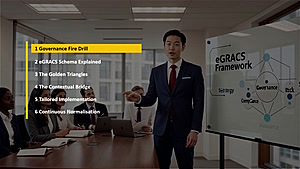
How do you possibly align a whole multiverse of overlapping, sometimes contradicting regulations? We're talking ISO, GDPR, HIPAA, NIST, without completely grinding your operations to a halt. Well, here's our roadmap for the explainer today. One, the governance fire drill.
Two, the eGRACS Schema explained. Three, the eGRACS golden triangles. Four, the eGRACS Model, the contextual bridge.
Five, the eGRACS Method, tailored enterprise implementation. And six, the eGRACS continuous evolution and normalization. Section one, the governance fire drill, breaking free from the compliance cage.
The contrast between the old way and the new way is absolutely stark. The old control-based frameworks operate in these entirely siloed universes, which just leads to redundant efforts, overlapping standards, and crazy high operational costs. But the new eGRACS approach is a unified architecture.
It fuses those global standards together to create a single source of truth, completely eliminating the bloat. Now, what's really interesting about this approach is the total shift in behaviour. We're moving away from flat static checklists that just give you basic checkbox compliance and literally break the second a major update happens.
Instead, we're dynamic feedback loops. We're talking about a living system built for continuous improvement, self-balancing ecosystems, and real adaptive resilience. Section two, the eGRACS Schema explained.
The rule of three. So how does this actually work? The Schema is built on three interconnected components. First up, you have the Framework.
That is your strategic structure holding 120 unified ICT controls. Second is the Model, which serves as a contextual bridge for real-world industry translation. And third is the Method, your operational playbook for tailored on-the-ground execution.
Together, they completely unify risk, security, and audits. I really want to highlight the massive impact of this specific number right here, 120. These are 120 unified ICT controls, meticulously fused from 14 international standards and 22 global regulations.
By consolidating everything down to this finite set, the Schema cuts right through that confusing multiverse of fragmented spreadsheets you're probably dealing with today. Section three, the eGRACS Framework. The golden triangles.
The geometry of control. Let's move to and see how this builds out the structural core. A golden triangle is a set of three independent controls that form a self-balancing micro ecosystem.
Because they're structurally linked, kind of like the three legs of a stool, if a new regulation updates one of those controls, the others naturally adapt to the new context collectively. Nothing breaks. This triad structure means structural integrity is always maintained.
And when you scale this across your entire enterprise, those 120 controls form exactly 40 of these miniature self-balancing ecosystems. They actively shift your governance from a flat static control inventory right into a truly dynamic control architecture. These triangles form what we call a tiered fractal hierarchy.
You start at the core tier for your foundational strategic pillars, cascade down into the strategic tier, move to the operational tier, and finally hit the tactical tier for your day-to-day hands-on execution. Because it's fractal, this Framework expands fluidly, literally like a living tree, maturing perfectly in step with your business. Section four, the eGRACS Model.
The contextual bridge, translating theory into reality. So how do we apply this massive architecture to your specific industry? The Model provides three actionable artifacts to turn theory into ground-level reality. You get eGRACS practices for real-world applications.
You get eGRACS templates offering pre-designed policies and reports. And you get eGRACS SOPs, your literal step-by-step implementation instructions. It eliminates the guesswork.
Basically, the eGRACS Model speaks your language. It brilliantly bridges the gap, translating those 120 abstract unified controls into the precise, strict demands of frameworks like ISO 27001, GDPR, HIPAA, and PCI DSS. This is exactly what global leaders need to finally get some sleep.
Section five, the eGRACS Method, tailored enterprise implementation, directional strategies. Now, how do we weave this right into your company's unique DNA? You've got two directional strategies here. Top-down implementation enforces strategic vision directly from the board.
Or you've got bottom-up transformation, which iteratively fixes processes right in the trenches for lower-maturity organizations. The Method bends and moulds to fit your exact cultural readiness. But for complex, global businesses, here's a real game-changer, the hybrid approach.
Large enterprises just do both simultaneously. They use the eGRACS as a diagnostic and implementation scaffold. This gives the board a single source of truth from the top-down, while ground-level teams fix their operational workflows from the bottom-up.
Section six, the eGRACS continuous evolution and normalization, the dynamic system. So the crucial point is, how does this architecture survive the rapid, inevitable shifts in technology and international law? It survives through a continuous feedback loop. You systematically evaluate progress, refine your controls, adapt to internal culture, and achieve right-sized governance.
It's a proactive system synchronized perfectly with the company beat. Externally, this mechanism uses global evolution mapping. When external laws shift, like an update to the EU AI Act or the RBI's cybersecurity framework, the Schema continuously harmonizes.
It automatically propagates those changes through every single layer of your fractal hierarchy, keeping your governance incredibly tight and totally future-proof. I want to summarize the core philosophy of our explainer today with this thought. It's not about more control.
It's about right-sized control, perfectly aligned to what the business actually needs. That hits the nail right on the head. Effective control isn't a cage.
It's the very structure that enables you to innovate safely. I'll leave you with this final provocative question. As an enterprise leader, are you going to continue to merely survive the chaotic governance fire drill, or are you ready to build the dynamic architecture that actually sets your business free? It's a critical choice for your future.
Thank you so much for joining me for this explainer. I really hope this deep dive sparks some great ideas for your own organization.
Subscribe to Our Video Updates
Stay informed with the latest eGRACS tutorials, insights, and strategies by subscribing to our video updates.
Looking for more?
🔍Search🏆Accreditation
eGRACS Accrediation

🤝Calling Consultants
Independent Consultants

🤽Video Explainers
What is eGRACS
🎧Vodcasts
eGRACS Framework Intro